

Yes, a factory or business in Punjab that installs rooftop solar can usually save income tax through accelerated depreciation on solar. Solar power systems fall in the 40% depreciation block, so a large part of the plant cost can be written off against business profit in the first few years. Here is how it works, in simple words, and what to check with your CA before you invest.
What is accelerated depreciation on solar?
Depreciation is the yearly deduction a business claims for wear and tear on its assets. Most plant and machinery is depreciated at a normal rate. Renewable energy devices, including solar power generating systems, are placed in a separate block with a higher rate of 40% on the written down value (WDV). Because more of the cost is claimed in the early years, it is called “accelerated” depreciation.
From 1 April 2026, the new Income-tax Act, 2025 and the Income-tax Rules, 2026 replaced the old 1961 Act. The depreciation table still lists renewable energy devices at 40% WDV, so the benefit continues under the new law.
Who can claim it?
- Companies, partnership firms, LLPs and proprietors who own the solar plant and use it for their business.
- Factories, cold storages, textile and hosiery units, steel and forging units, warehouses, hospitals, schools run as businesses, and commercial buildings.
- The plant must be owned by the business (CAPEX model). If you buy power under a RESCO/OPEX agreement, the developer owns the plant and claims the depreciation, not you.
- Homes and individuals without business income cannot claim it.
How the 40% works: a simple example
The table below uses an example figure only: a plant costing ₹50 lakh (depreciable cost) and an assumed effective tax rate of 25%. Your real plant cost and tax rate will be different, so treat this as an illustration of the method, not a quote.
| Year | Opening WDV | Depreciation at 40% | Closing WDV | Tax saved (at 25%) |
|---|---|---|---|---|
| Year 1 | ₹50.0 lakh | ₹20.0 lakh | ₹30.0 lakh | ₹5.0 lakh |
| Year 2 | ₹30.0 lakh | ₹12.0 lakh | ₹18.0 lakh | ₹3.0 lakh |
| Year 3 | ₹18.0 lakh | ₹7.2 lakh | ₹10.8 lakh | ₹1.8 lakh |
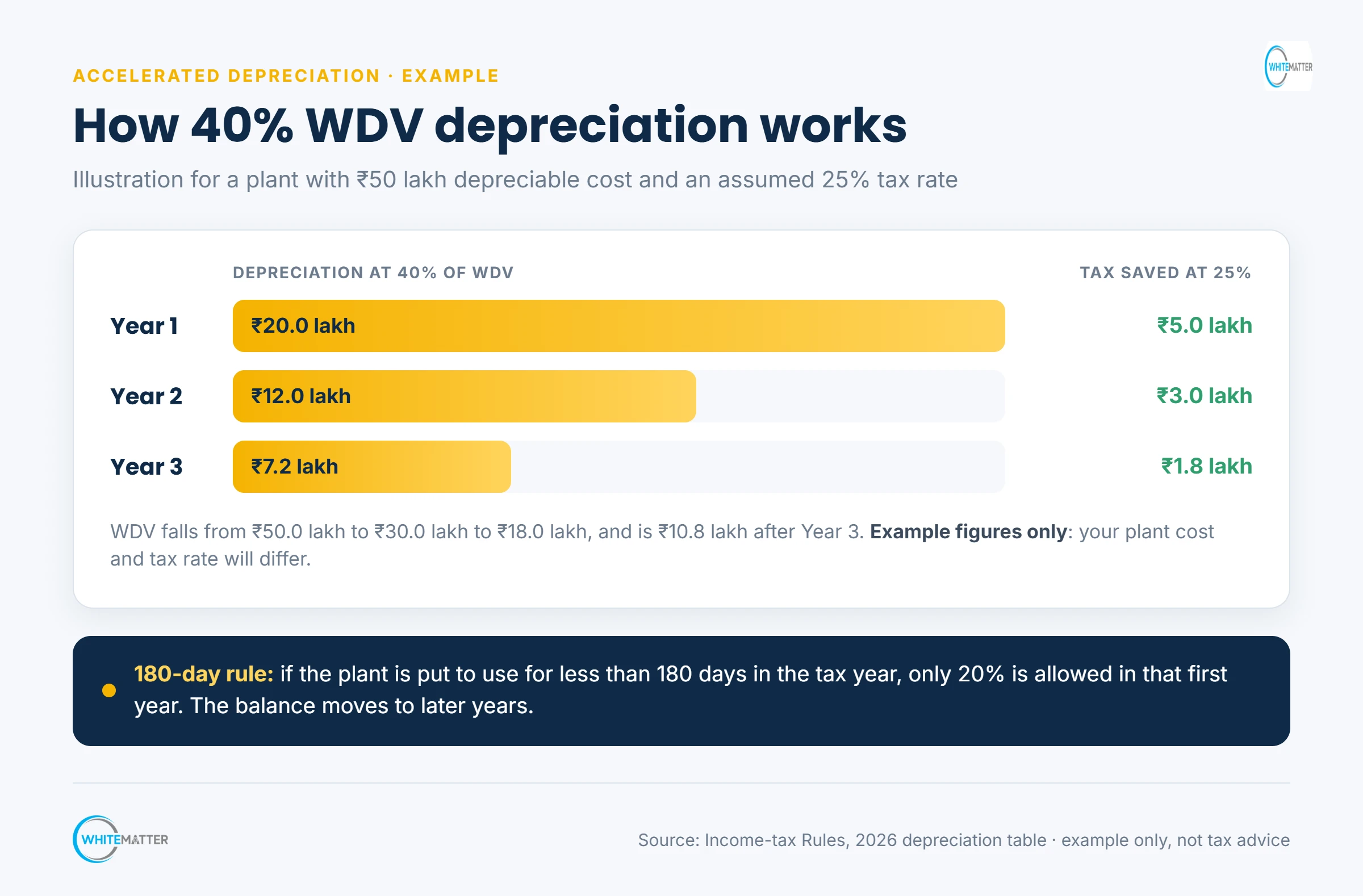
In this example, close to 80% of the cost is written off in three years. Together with lower electricity bills, this tax saving shortens the real payback of an industrial rooftop plant.
The 180-day rule: timing matters
If the plant is put to use for less than 180 days in a tax year, only half the rate (20%) is allowed in that first year. The balance is not lost, it simply moves to later years. Many businesses therefore plan installation and commissioning so the plant is running before the 180-day cut-off. Talk to us early so the project schedule matches your tax planning.
Other tax points business owners should know
GST on solar systems is lower now
The GST Council cut GST on renewable energy devices, including solar power based devices, from 12% to 5%, effective 22 September 2025. This lowers the upfront cost of a plant. Whether you can claim input tax credit on the GST you pay depends on your business and how the plant is used, so confirm this with your CA.
Companies under the lower tax regime
Companies that opted for the concessional corporate tax regime have their depreciation capped at 40%. Since solar is already at 40%, the solar benefit is not reduced. Some extra benefits, such as additional depreciation for new plant and machinery in manufacturing, may not be available under that regime.
Additional depreciation for manufacturers
Manufacturing units buying new plant and machinery may also be eligible for additional depreciation in the first year, subject to conditions. Whether your solar plant qualifies depends on your facts and the current law, so please check with your tax advisor before counting on it.
Checklist: how to make sure you can claim it

- Buy in the business name (company, firm or proprietorship), not a personal name.
- Get proper tax invoices for modules, inverters, structure and installation, with your GSTIN.
- Keep the commissioning record and the date the plant started generating, as this decides the 180-day rule.
- Keep net metering / PSPCL approval papers and the handover file with your accounts.
- Record the plant in the right block (renewable energy devices) in your fixed asset register.
- Discuss with your CA before the financial year end, not after.
How Whitematter helps businesses in Punjab
Whitematter Energy Solutions is a Ludhiana-based company focused on commercial and industrial rooftop solar. We are an authorized Havells channel partner for industrial rooftop solar, and our founder Harpal Singh (PMP®) brings 17+ years of experience in the electrical energy industry.
We handle the full project, turnkey: site assessment, 3D design and quotation, documentation and approvals, material delivery, installation and commissioning, inspection and handover. You receive a clean set of invoices and commissioning documents that your CA can use for the depreciation claim. We work in Ludhiana, Moga, Bathinda, Barnala, Mandi Gobindgarh and across Punjab. See our work on the projects page.
FAQ
What is the depreciation rate for solar panels for a business in India?
Solar power generating systems are in the renewable energy devices block at 40% on written down value under the current income tax rules. Half of this (20%) applies in the first year if the plant is used for less than 180 days.
Can I claim accelerated depreciation if I take solar on RESCO / OPEX?
No. Depreciation goes to the owner of the asset. In a RESCO or OPEX model the developer owns the plant, so the developer claims it. You only pay for the power you use.
Does the new Income-tax Act, 2025 remove the solar depreciation benefit?
No. The new Act and the Income-tax Rules, 2026 came into force on 1 April 2026, and renewable energy devices continue to be listed at 40% WDV.
Is the depreciation claimed on the price including GST?
If you claim input tax credit on the GST, depreciation is usually claimed on the cost without that GST. If you do not claim credit, the GST may form part of the cost. Your CA can confirm the right treatment.
Get a free plant assessment
Want to know how much your factory can save on both electricity bills and tax? Book a free plant assessment with Whitematter. Call or WhatsApp +91 99884 32432, email harpal@whitematter.in, or contact us here.
Note: This article is general information, not tax advice. Tax rules can change and depend on your business; please consult your chartered accountant before making a claim.
Sources
- Income Tax Department – Income-tax Act, 2025 comes into force from 1 April 2026
- Income Tax Department – Income-tax Rules, 2026 (Rule 25, depreciation)
- PIB – GST on renewable energy devices rationalised to 5%
- Patron Accounting – Depreciation rules 2026: block of assets and rates
- TaxGuru – Depreciation under the Income-tax Act, 2025