

If your factory in Punjab is planning a rooftop solar plant, one of the first choices you will make is the metering arrangement. In simple words: net metering lets you use your solar units first and offset exported units against units you import, while gross metering sends all your solar power to the grid and you are paid for it at a fixed feed-in tariff. For most industries that use power during the day, net metering for industries in Punjab (or net billing for larger plants) usually gives better value than gross metering, but the right answer depends on your plant size, load pattern and sanctioned load.
This guide explains each option available under the PSERC rooftop solar regulations in plain language, so you can talk to PSPCL and your solar installer with confidence.
What the Punjab rules allow today
Rooftop solar in Punjab is governed by the PSERC (Grid Interactive Rooftop Solar Photo Voltaic Systems) Regulations, notified on 18 August 2021 and amended in April 2026. According to PEDA, these rules now allow net metering, net billing, gross metering, group net metering, virtual net metering and behind-the-meter arrangements. PSPCL handles the application, technical feasibility, meter installation and billing through its online solar portal.
Net metering: use first, export the surplus
With net metering, a bidirectional meter records the units you import from PSPCL and the units your plant exports. At billing time, the two are netted off and you pay only for the net units you used. Electricity duty also applies only to the net billed amount.
- Capacity: linked to your sanctioned load or contract demand, with a maximum of 500 kWp under net metering.
- Settlement: exported units are adjusted on a yearly basis. Under the 2026 amendment, credits that remain unadjusted at the end of the financial year are compensated at 75% of the PSERC-approved feed-in tariff.
- Best for: small and mid-size units that run mainly in daytime shifts, such as hosiery, knitting, small engineering and workshop units.
The key point: every solar unit you use yourself saves you the full retail tariff you would otherwise pay. That is why net metering works so well when your consumption matches your generation.
Net billing: for larger plants above 500 kWp
Net billing also uses a bidirectional meter, but the money is calculated differently. Units you import are billed at your normal retail tariff, and units you export are credited at the feed-in tariff. The difference shows on your bill.
- Capacity: linked to your sanctioned load or contract demand, and not limited to 500 kWp.
- Best for: larger industries, such as steel re-rolling, textile and processing units, that need a bigger plant than net metering allows.
Because exported units earn less than imported units cost, a net billing plant should be sized so that most of the solar power is consumed on site.
Gross metering: sell everything to the grid
Under gross metering, all the solar power generated is exported to the grid and credited at the feed-in tariff. Your factory’s own consumption continues to be billed at the regular retail tariff. In effect, the plant works like a small power station that sells to PSPCL.
- Capacity: linked to your sanctioned load or contract demand, with no 500 kWp cap.
- Best for: owners whose roof is large but whose daytime load is small, or who want a simple income stream instead of bill savings.
For most manufacturing units, gross metering gives lower returns, because the feed-in tariff is generally lower than the retail industrial tariff you pay.
Other options worth knowing
Group net metering
If you have several connections in the same tariff category, for example two sheds of the same company in one distribution area, you can install one plant at one location and adjust its surplus against the other connections. The plant must be between 5 kWp and 500 kWp and within the combined sanctioned load of the participating connections.
Behind-the-meter
Here the plant runs behind your meter and you simply use all the power on site. There is no net metering or net billing, and any accidental export is not paid for. It needs prior approval and suits factories whose daytime load is always higher than the plant output.
Side-by-side comparison
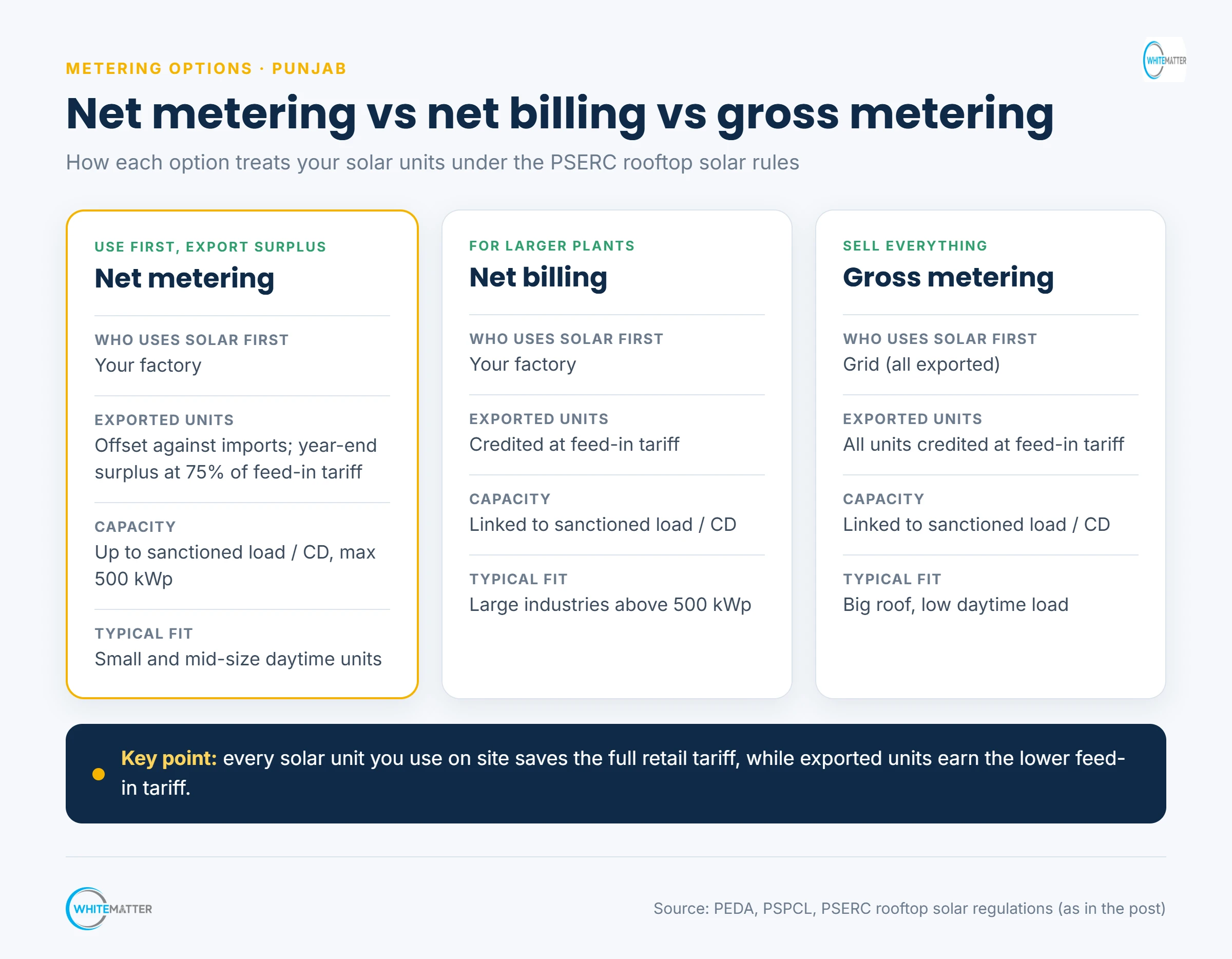
| Point | Net metering | Net billing | Gross metering |
|---|---|---|---|
| Who uses the solar first? | Your factory | Your factory | Grid (all exported) |
| Value of exported units | Offset against imports; year-end surplus at 75% of feed-in tariff | Credited at feed-in tariff | All units credited at feed-in tariff |
| Capacity limit | Up to sanctioned load / CD, max 500 kWp | Linked to sanctioned load / CD | Linked to sanctioned load / CD |
| Typical fit | Small and mid-size daytime units | Large industries above 500 kWp | Big roof, low daytime load |
Technical points PSPCL checks
Before approval, PSPCL checks technical feasibility online. One important condition is that the total solar capacity connected to a distribution transformer, including your proposed plant and earlier pending applications, should stay within 80% of the transformer’s capacity. If your area transformer is already full, your application can go on a priority waitlist. A bidirectional meter is installed, and the plant must be commissioned within the time allowed after approval.
How to choose: a quick checklist
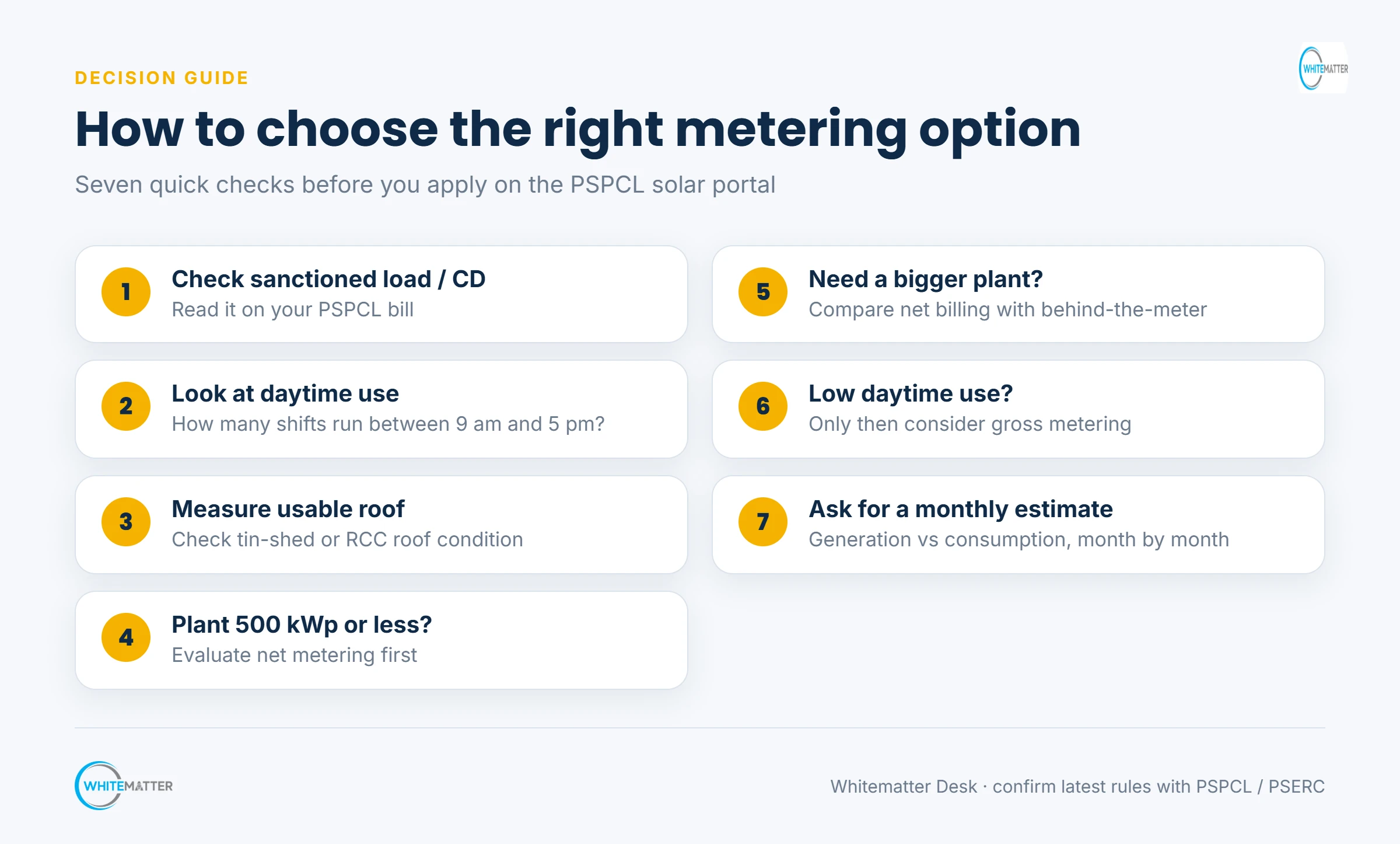
- Check your sanctioned load or contract demand on your PSPCL bill.
- Look at your daytime consumption: how many shifts run between 9 am and 5 pm?
- Measure your usable roof area and check the condition of tin sheds or RCC roofs.
- If the plant you need is 500 kWp or less, net metering is usually the first option to evaluate.
- If you need a bigger plant, compare net billing with a behind-the-meter design.
- Consider gross metering only if your own daytime use is small compared with what the roof can generate.
- Ask your installer to show a month-by-month generation vs consumption estimate before you decide.
How Whitematter helps
Whitematter Energy Solutions in Ludhiana focuses on commercial and industrial rooftop solar. As an authorized Havells channel partner for industrial rooftop solar, we deliver turnkey projects: site assessment, 3D design and quotation, PSPCL documentation and approvals, material delivery, installation and commissioning, inspection and handover. Our founder, Harpal Singh (PMP®), brings 17+ years of experience in the electrical energy industry. We work across Ludhiana, Moga, Bathinda, Barnala, Mandi Gobindgarh and the rest of Punjab. You can see some of our work on our projects page.
Frequently asked questions
Can an industry in Punjab get net metering for a plant above 500 kWp?
No. Under the current PSERC rules, net metering is capped at 500 kWp. Larger plants can use net billing, gross metering or a behind-the-meter arrangement, all linked to your sanctioned load or contract demand.
What happens to extra solar units at the end of the year under net metering?
Units that are not adjusted against your consumption by the end of the financial year are compensated at 75% of the feed-in tariff approved by PSERC, as per the 2026 amendment.
Is gross metering a good idea for a factory?
Usually not, if the factory uses most of its power in daytime. Using solar on site saves the full retail tariff, while gross metering pays only the feed-in tariff for every unit.
Who applies to PSPCL, me or the installer?
The application is in the consumer’s name on the PSPCL solar portal, but a turnkey installer like Whitematter prepares the documents, single line diagram and follow-ups for you.
Get a free plant assessment
Not sure which metering option suits your unit? Share your last few PSPCL bills and we will assess your load, roof and best metering option, free of charge. Call or WhatsApp +91 99884 32432, email harpal@whitematter.in, or contact us here.
Note: Rules and tariffs change from time to time. Please confirm the latest provisions with PSPCL or PSERC before you finalise your plant.
Pingback: CAPEX vs RESCO Solar for Punjab Factories: Which Fits?