

Can you install solar panels on a tin-shed factory roof? Yes. Most metal-sheet (tin-shed) roofs on factories in Ludhiana and across Punjab can carry an industrial rooftop solar plant, as long as the roof sheet, the purlins below it and the fixing method are checked first. Get the structure, the load and the leak-proofing right, and tin-shed roof solar becomes one of the best investments for your factory.
This guide explains each of these in plain language, so you know what to ask your installer before you sign.
Why tin-shed roofs suit industrial rooftop solar
Factory sheds in Punjab often have large, open roofs with no water tanks or stairs in the way. That makes them a natural fit for industrial rooftop solar in Ludhiana and nearby towns:
- Large, unused area: the roof is already there, so no extra land is needed.
- Light, low structures: panels can sit close to the sheet on short rails, which keeps added weight and wind exposure low.
- Daytime use: most factories run during the day, when the plant is producing power.
- Some shade for the shed: panels sit above part of the sheet, which can block some direct sun from the roof.
Step 1: Check the roof before anything else
A solar plant is built to last many years. The roof under it must be ready for that. Before any design work, a proper site visit should look at:
- Sheet condition: rust, holes, thin or brittle areas, and how many years of life the sheet has left.
- Sheet profile: trapezoidal, corrugated or standing-seam. This decides which mounting method can be used.
- Purlins and trusses: their size, spacing and condition. These carry the real load.
- Roof slope and direction: which way each side faces and how steep it is.
- Shade: chimneys, turbo ventilators, skylights, tanks and taller buildings next door.
If the sheet is near the end of its life, replace it before solar goes up. Changing a sheet later means taking the panels off, storing them and fitting them again.
Step 2: Choose the right mounting structure
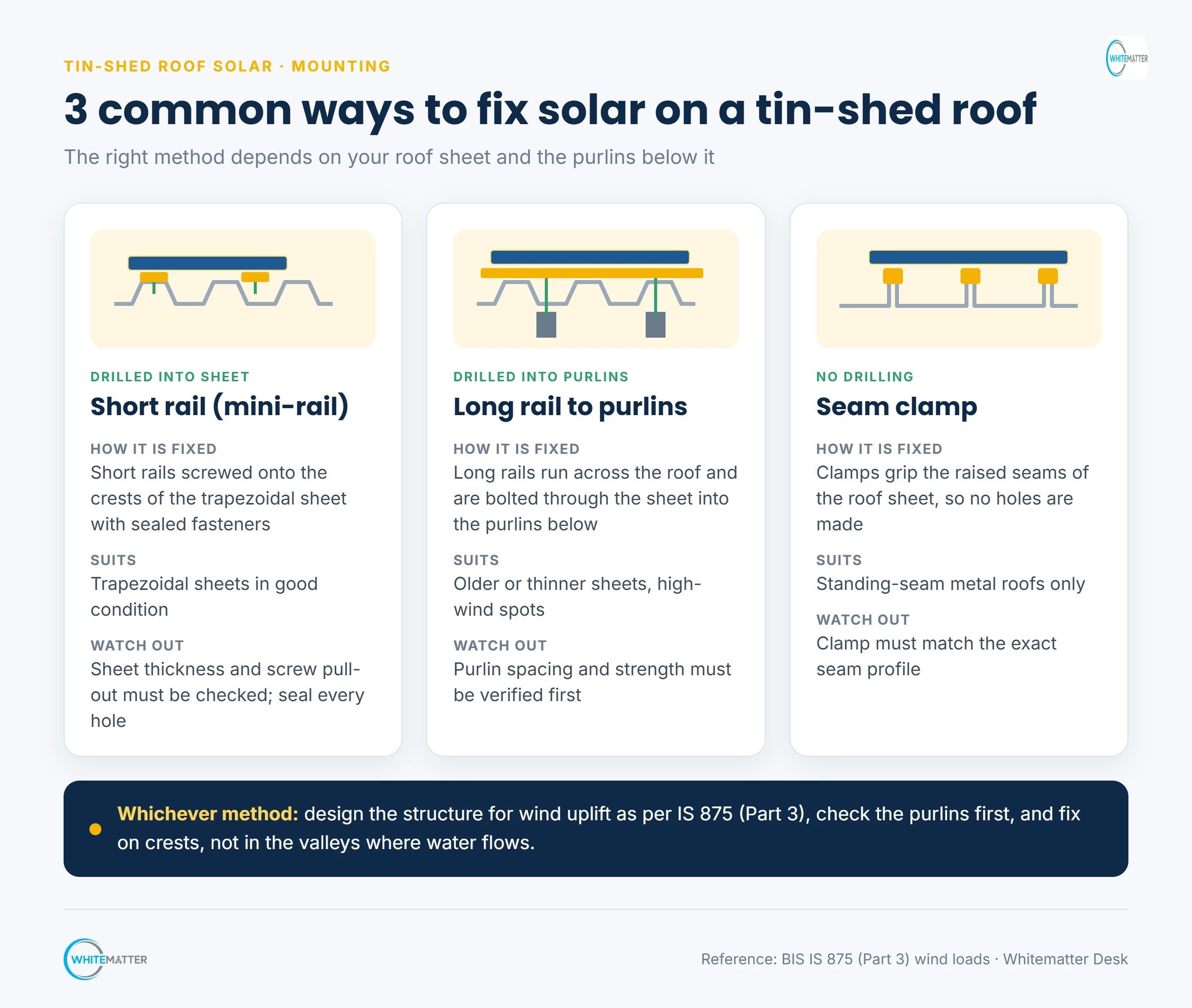
On metal sheet roofs there are three common ways to fix the module mounting structure (MMS):
| Method | How it is fixed | Holes in sheet? | Best suited to |
|---|---|---|---|
| Short rail (mini-rail) | Short rails screwed onto the crests of the sheet | Yes, small and sealed | Trapezoidal sheets in good condition |
| Long rail to purlins | Rails bolted through the sheet into purlins below | Yes, at purlin points | Older or thinner sheets, high-wind spots |
| Seam clamp | Clamps grip the raised seams of the sheet | No | Standing-seam roofs only |
Structure material
For reference, MNRE’s rooftop solar guidelines under PM Surya Ghar (a residential scheme) list hot-dip galvanised iron, hot-dip galvanised mild steel, aluminium and, since an amendment reported in May 2026, zinc-aluminium-magnesium (ZAM) alloy as accepted MMS materials. For a factory, the choice should also take your environment into account. Units with dyeing, chemical or plating work may need better corrosion protection. Also avoid direct contact between different metals without isolation, as this can cause corrosion over time.
Step 3: Get the load right
On a tin shed, two kinds of load matter:
- Dead load: the weight of panels, rails and clamps. A low-profile structure adds limited weight, but the purlins must still be checked for it.
- Wind load: on light metal roofs, wind trying to lift the panels (uplift) is often the bigger risk. In India, wind loads on buildings and structures are designed as per BIS IS 875 (Part 3).
A good design checks how well each screw or bolt holds in the sheet or purlin, how far apart the fixing points are, and extra wind near roof edges and corners. Ask for the structural calculation, not just a drawing.
Step 4: Stop leaks before they start
Leakage is the biggest worry owners have about tin-shed solar. Most leaks come from poor workmanship, not from solar itself. Good practice:
- Fix on the crests (raised ribs) of the sheet, never in the valleys where water flows.
- Use self-drilling screws with EPDM washers, tightened correctly (not over-tightened).
- Keep the number of holes to the minimum the design needs.
- Lay out rails so they do not block the flow of rainwater.
- Avoid walking directly on the sheet. Plan walkways for installation and cleaning.
- Do a water test before the monsoon and inspect the roof from inside after the first heavy rain.
Safety and maintenance on sheet roofs
A tin shed is not a floor. Skylights and old sheets can break under a person’s weight. Plan walkways and safety lines for your maintenance team. Run cables in trays instead of leaving them lying on hot sheets, and keep clear access paths so that panels can be cleaned and checked. A simple solar maintenance and AMC plan keeps both the plant and the roof in good shape.
Your tin-shed solar checklist
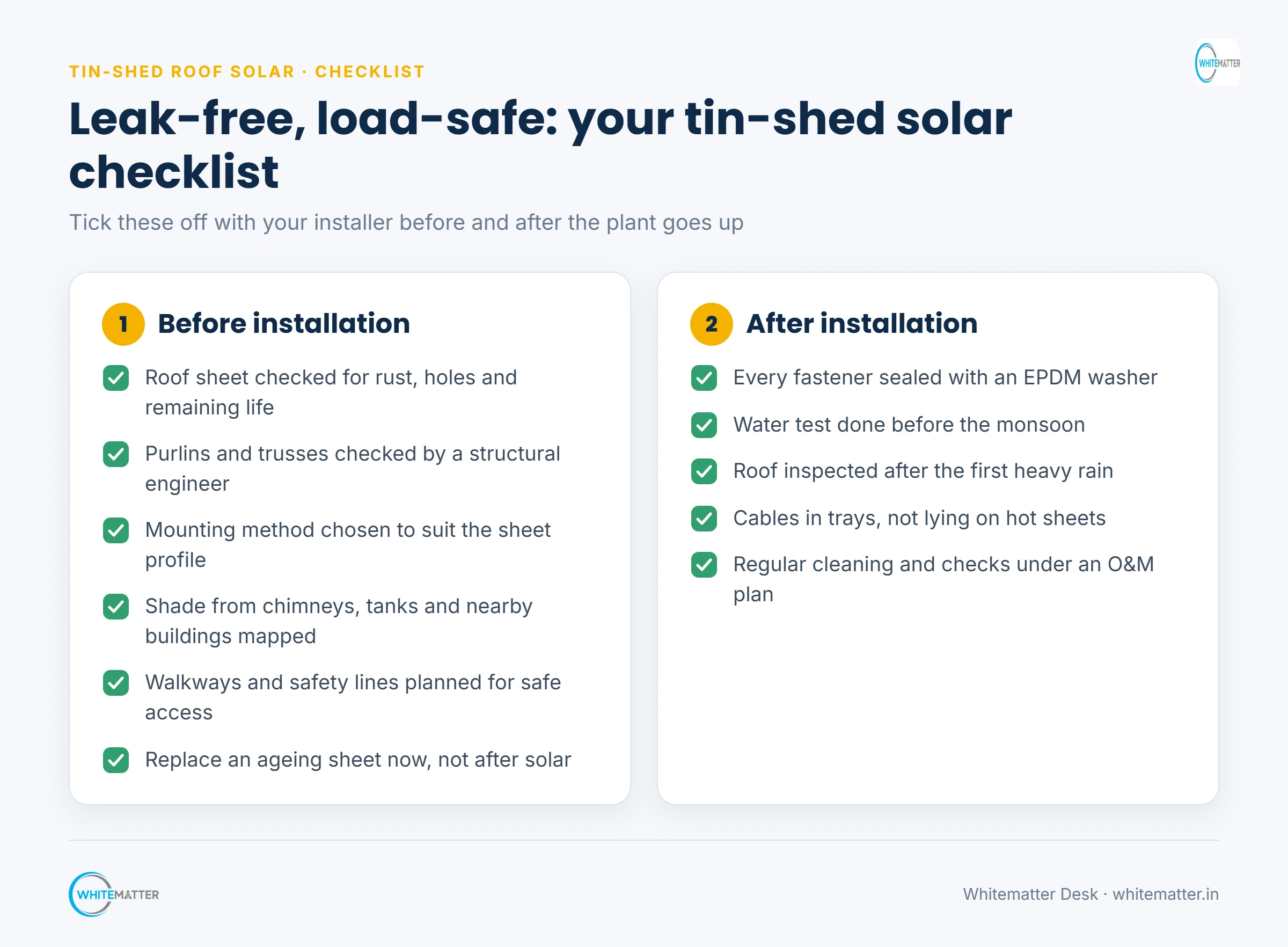
- Roof sheet checked, and replaced first if it is ageing
- Purlins and trusses checked by a structural engineer
- Mounting method matched to the sheet profile
- Structure designed for wind as per IS 875 (Part 3)
- Sealed fasteners on crests, minimum holes
- Walkways, safety lines and cable trays planned
- Water test before monsoon, inspection after first rain
How Whitematter handles tin-shed projects
Whitematter Energy Solutions focuses on commercial and industrial (C&I) rooftop solar and is an authorised Havells channel partner for industrial rooftop solar. Our founder, Harpal Singh, is PMP®-certified and has more than 17 years in the electrical energy industry. We handle the full job, turnkey:
- Site assessment, including roof sheet and purlin check
- 3D design and quotation
- Documentation and approvals
- Material delivery
- Installation and commissioning
- Inspection and handover
We work with factories in Ludhiana, Moga, Bathinda, Barnala, Mandi Gobindgarh and across Punjab. You can see some of our work on our projects page.
FAQs
Will solar panels cause my tin roof to leak?
Not if the plant is installed properly. Leaks usually come from fixing in the valleys, missing or poor washers, or people walking on the sheets. Sealed fixings on the crests and a water test before the monsoon prevent most problems.
Can an old tin shed carry a solar plant?
It depends on the sheet and purlins. If the sheet is close to the end of its life, replace it first. If the purlins are weak, the structure may need strengthening. A site check will tell you which applies.
Is drilling into the roof always needed?
No. Standing-seam roofs can use seam clamps with no holes. Trapezoidal and corrugated sheets usually need sealed fasteners.
What if I need to repair the roof later?
Small repairs can often be done around the panels, but a full sheet change means removing them. That is why we suggest fixing roof problems before installation.
Get a free plant assessment
Planning solar on your factory’s tin shed? Our team will check your roof, purlins and electricity use, and give you a clear design and quotation. Call or WhatsApp +91 99884 32432, email harpal@whitematter.in, or book a free assessment here.
Pingback: Solar Plant Size for Factory: Use Your PSPCL Bill