

What solar plant size does your factory need? Start with your PSPCL bill. Work out how many units you use in daytime, divide that by what 1 kW of panels can produce in a day, and then check the answer against your roof area and your sanctioned load or contract demand. The smallest of these limits sets the right solar plant size for your factory.
This guide walks you through each step with a worked example, so you can spot a proposal that is too big or too small.
Why the right plant size matters
A solar plant is a long-term investment, so the size you choose on day one stays with you for many years. Getting it wrong costs money both ways:
- Too small: you keep paying the full industrial tariff on units the roof could have produced.
- Too big: you export extra units to the grid, and those units are usually worth less than the units you use yourself. Under the Punjab rules, net metering credits left over at the end of the financial year are paid at only 75% of the feed-in tariff approved by PSERC.
- Not allowed: a plant above your sanctioned load or contract demand, or above the net metering cap, will not be approved in that form.
Step 1: Read 12 months of your PSPCL bill
Collect your last 12 monthly bills, not just one. Factory consumption changes with seasons, orders and shifts, and summer and winter months can look very different. From the bills, note:
- Units consumed (kWh) each month and the yearly total.
- Sanctioned load (kW) or contract demand (kVA), printed on the bill.
- Tariff category (small power, medium supply or large supply).
Step 2: Find your daytime units
Solar panels only produce power when the sun is up. The units that matter most are the ones your factory uses between roughly 9 am and 5 pm. A three-shift unit uses a good share of its power at night, which solar cannot cover directly.
You can estimate your daytime share from your shift timings, or more accurately from the time-of-day data in your meter, which your installer can help read. Multiply your monthly units by this share to get your daytime units per month.
Step 3: Convert daytime units into plant size
Government guidance gives a useful thumb rule. According to UPNEDA’s rooftop solar FAQ, on a clear sunny day a 1 kWp rooftop system can generate about 4 to 5.5 units. Real output across the year is lower on foggy winter days and cloudy monsoon days, so a careful first estimate uses the lower end of that range.
The simple formula is:
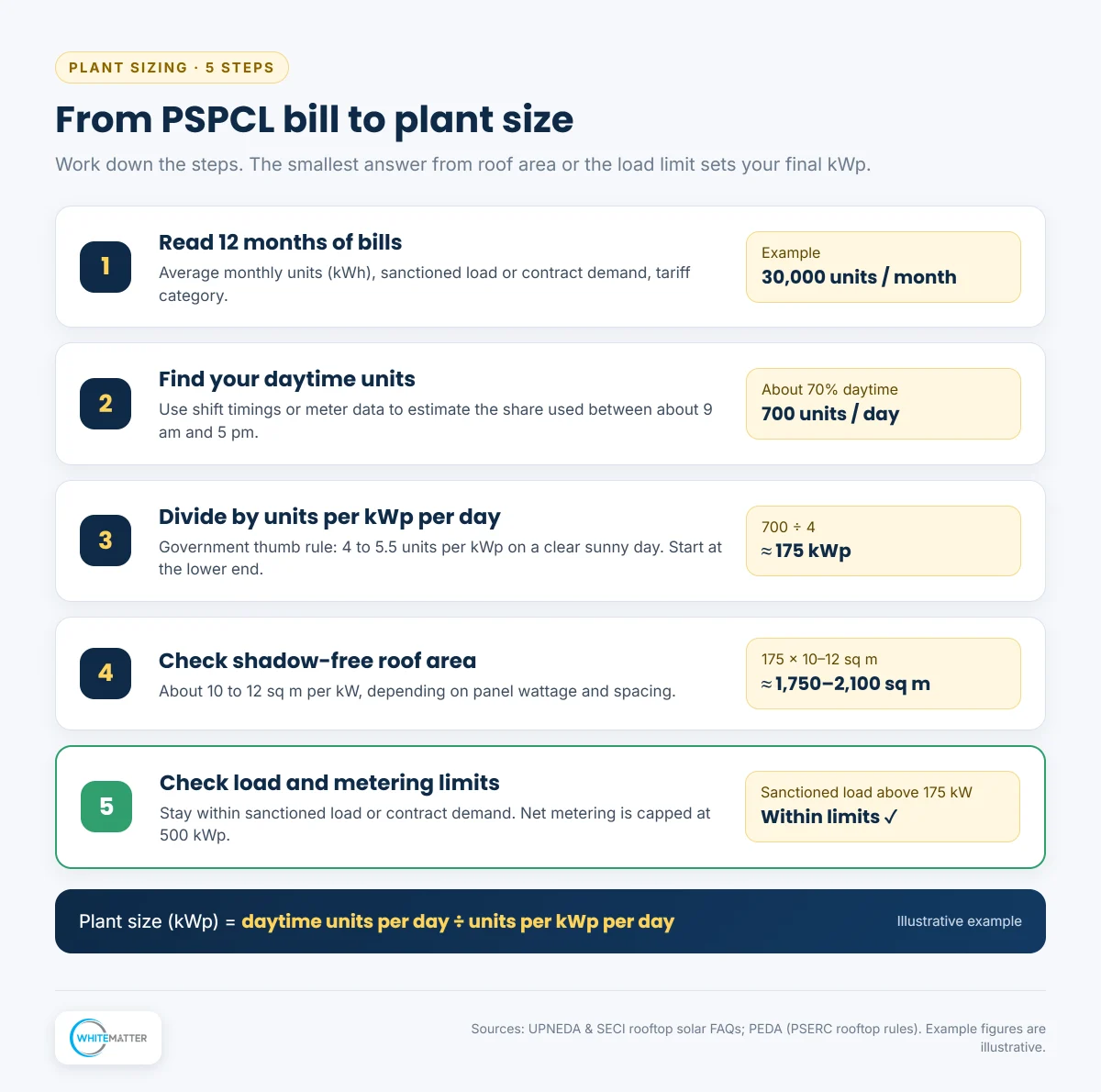
Plant size (kWp) = Daytime units per day ÷ Units per kWp per day
Treat this as a starting point. A proper design uses a generation simulation for your exact site, tilt and shade.
Step 4: Check your roof area
Next, see whether the roof can hold that plant. SECI’s FAQ says a 1 kW rooftop system generally needs about 12 sq m of flat, shadow-free area, while UPNEDA gives about 10 sq m. The exact figure depends on panel wattage, row spacing and walkways for cleaning.
- Count only shadow-free area. Leave out zones shaded by chimneys, turbo ventilators, tanks or taller buildings.
- On tin-shed roofs, check the sheet and purlins first. Our guide on solar on tin-shed factory roofs explains what to look for.
- If the roof is too small, the roof becomes your limit, or you can look at ground-mounted space on your premises.
Step 5: Check your sanctioned load and metering limit
Under the PSERC rooftop solar regulations, as described by PEDA, the capacity under net metering cannot exceed 500 kWp, and the capacity under net billing or gross metering is subject to your sanctioned load or contract demand. In practice:
- Your plant must stay within your sanctioned load or contract demand.
- If your plant is up to 500 kWp, net metering is usually the first option to look at.
- If you need a bigger plant, look at net billing or a behind-the-meter design.
- PSPCL also checks technical feasibility, including spare capacity on the local distribution transformer.
For a detailed comparison of these options, read our guide on net metering vs gross metering for industries in Punjab.
A worked example
Here is an illustrative example. The factory numbers below are made up to show the method; use your own bill data.
| Step | What you do | Example |
|---|---|---|
| 1. Monthly units | Average of 12 bills | 30,000 units per month |
| 2. Daytime share | From shift timings or meter data | About 70% → 21,000 units per month |
| 3. Daytime units per day | Divide by 30 days | 700 units per day |
| 4. Plant size | 700 ÷ 4 units per kWp per day | About 175 kWp |
| 5. Roof check | 175 kWp × 10 to 12 sq m | About 1,750 to 2,100 sq m shadow-free roof |
| 6. Limit check | Compare with sanctioned load / contract demand and the 500 kWp net metering cap | Within limits if sanctioned load is above 175 kW |
If this factory had only 1,200 sq m of usable roof, the roof would be the real limit, and the plant would be sized to fit the roof instead.
Common sizing mistakes to avoid
- Sizing from one bill. A single summer or winter bill can push the size too high or too low.
- Ignoring night shifts. Units used after sunset cannot be covered directly by solar.
- Forgetting future plans. A new machine line or extra shift changes the answer. Plan the layout so you can add capacity later.
Quick checklist before you ask for a quotation
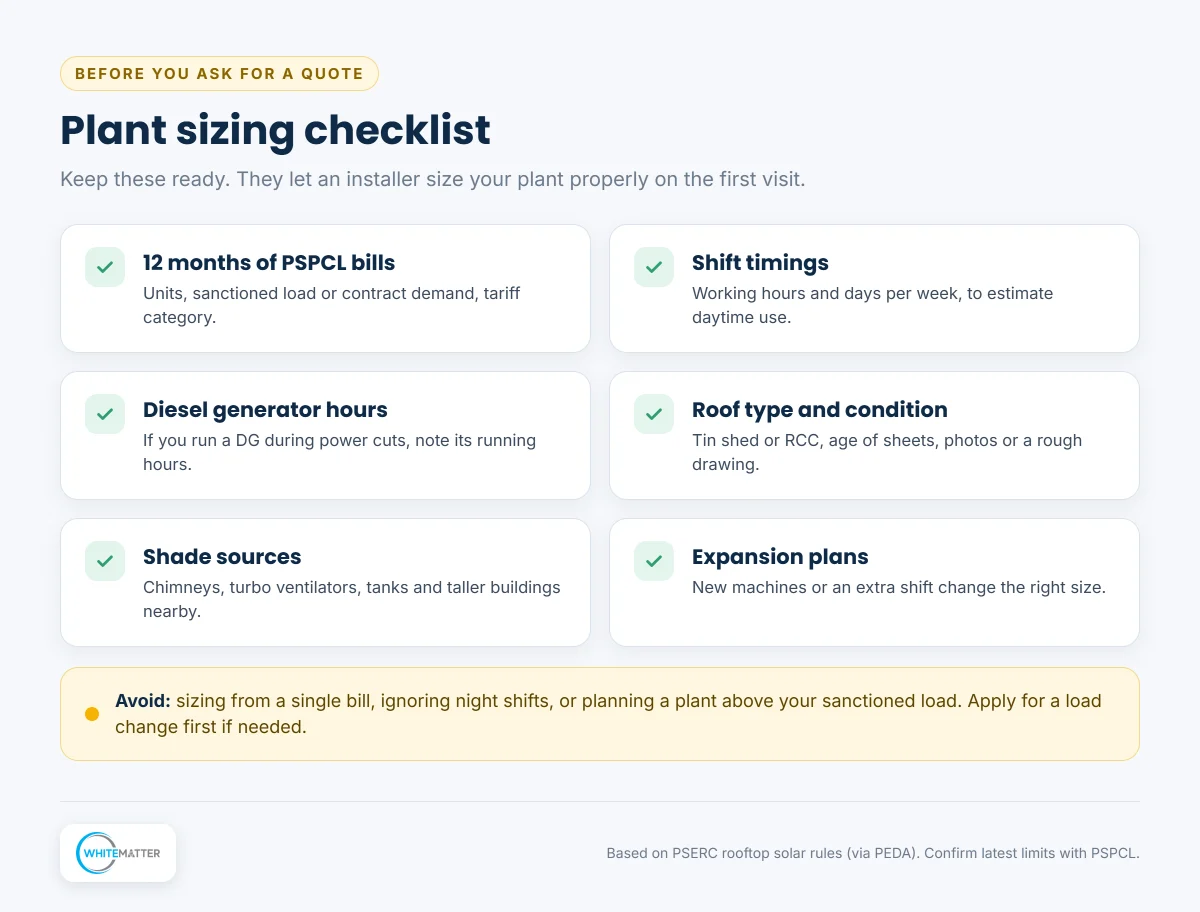
- 12 months of PSPCL bills (units, sanctioned load or contract demand, tariff category).
- Shift timings and the days your factory works each week.
- Diesel generator running hours, if any.
- Roof type, age and a rough drawing or photos of each shed.
- Shade sources on and around the roof.
- Any planned expansion in the next few years.
Also remember that solar plants bought by a business may qualify for tax benefits. See our guide on accelerated depreciation on solar.
How Whitematter sizes your plant
Whitematter Energy Solutions in Ludhiana focuses on commercial and industrial rooftop solar. As an authorized Havells channel partner for industrial rooftop solar, we offer a full turnkey service: site assessment, 3D design and quotation, documentation and approvals, material delivery, installation and commissioning, inspection and handover. Our founder, Harpal Singh (PMP®), has 17+ years of experience in the electrical energy industry. We serve factories in Ludhiana, Moga, Bathinda, Barnala, Mandi Gobindgarh and across Punjab. You can see some of our work on our projects page.
Frequently asked questions
Can my solar plant be bigger than my sanctioned load?
No. Under the PSERC rules, rooftop solar capacity is linked to your sanctioned load or contract demand. If you need a bigger plant, you may first need to apply to PSPCL for a higher load.
How many units will a 100 kW plant produce?
Using the government thumb rule of about 4 to 5.5 units per kWp on a clear sunny day, a 100 kWp plant may produce roughly 400 to 550 units on such a day. Annual output depends on weather, shade, tilt and maintenance, so ask for a site-specific generation estimate.
Should I size the plant to cover 100% of my bill?
Not always. For most factories, the best value comes from sizing the plant to your daytime use, because units you use yourself save the full tariff while extra exported units earn less.
Get a free plant sizing assessment
Send us your last 12 PSPCL bills and a few roof photos, and we will work out the right plant size for your factory, free of charge. Call or WhatsApp +91 99884 32432, email harpal@whitematter.in, or contact us here.
Note: Rules, limits and tariffs change from time to time. Please confirm the latest provisions with PSPCL or PSERC before you finalise your plant.