


How do you keep a factory solar plant producing at its best year after year? Clean the modules regularly, run simple monthly and yearly checks on inverters, cables and earthing, and track daily generation so problems are caught early. For most businesses in Ludhiana, the easiest way to do this is a clear annual maintenance contract (AMC) with the company that installed the plant.
This guide explains solar plant maintenance in Ludhiana and across Punjab in plain words: what to clean, what to check, how often, and what a good AMC should cover.
Why maintenance matters for industrial rooftop solar
A rooftop solar plant has no moving parts, so many owners think it needs no care. In real factory conditions that is not true. Industrial areas in Punjab see dust from roads and production, smoke, bird droppings and, in winter, haze and fog. All of these settle on the glass and block sunlight.
The effect is not small. An IIT Delhi study of 2001–2018 data, reported by Physics World, estimated that air pollution and dust cut the output of fixed solar panels across India by around 12%, with a similar loss for the northern region. Dirty modules on top of that mean fewer units, a smaller cut in your PSPCL bill and a longer payback.
Maintenance also protects safety. A factory roof plant runs at high DC voltage. Loose connectors, damaged cables or poor earthing can lead to faults, hot spots and, in the worst case, fire. Regular checks keep both your generation and your building safe.
What does solar O&M include?
O&M means operation and maintenance. For a commercial or industrial plant it usually has four parts:
- Module cleaning: removing dust and dirt from the panel glass with soft brushes and clean water.
- Preventive checks: inspecting modules, structure, cables, connectors, junction boxes, inverters, earthing and lightning protection on a fixed schedule.
- Monitoring: watching daily and monthly generation on the inverter portal and comparing it with what the plant should produce.
- Corrective repairs: fixing faults quickly and handling warranty claims with the manufacturers.
Module cleaning: the right way
Cleaning is the single biggest maintenance task. How often you clean depends on your site. A plant next to a busy road, a foundry or a dusty yard gets dirty much faster than one in a clean area. There is no single rule: dusty sites may need cleaning every few weeks, especially in dry months, while cleaner sites need it less. The best guide is your own generation data: if output drops on clear days, it is time to clean.
Simple cleaning rules
- Clean early in the morning or late evening, when modules are cool. Cold water on hot glass can stress it.
- Use soft brushes or mops and clean water. Avoid hard brushes, detergents, scrapers and high-pressure jets unless the module maker allows them.
- Hard or salty water can leave marks; use softer water where possible.
- Never walk on modules. On tin-shed roofs, use proper walkways and safety lines.
- Follow the module manufacturer’s cleaning instructions so the warranty stays valid.
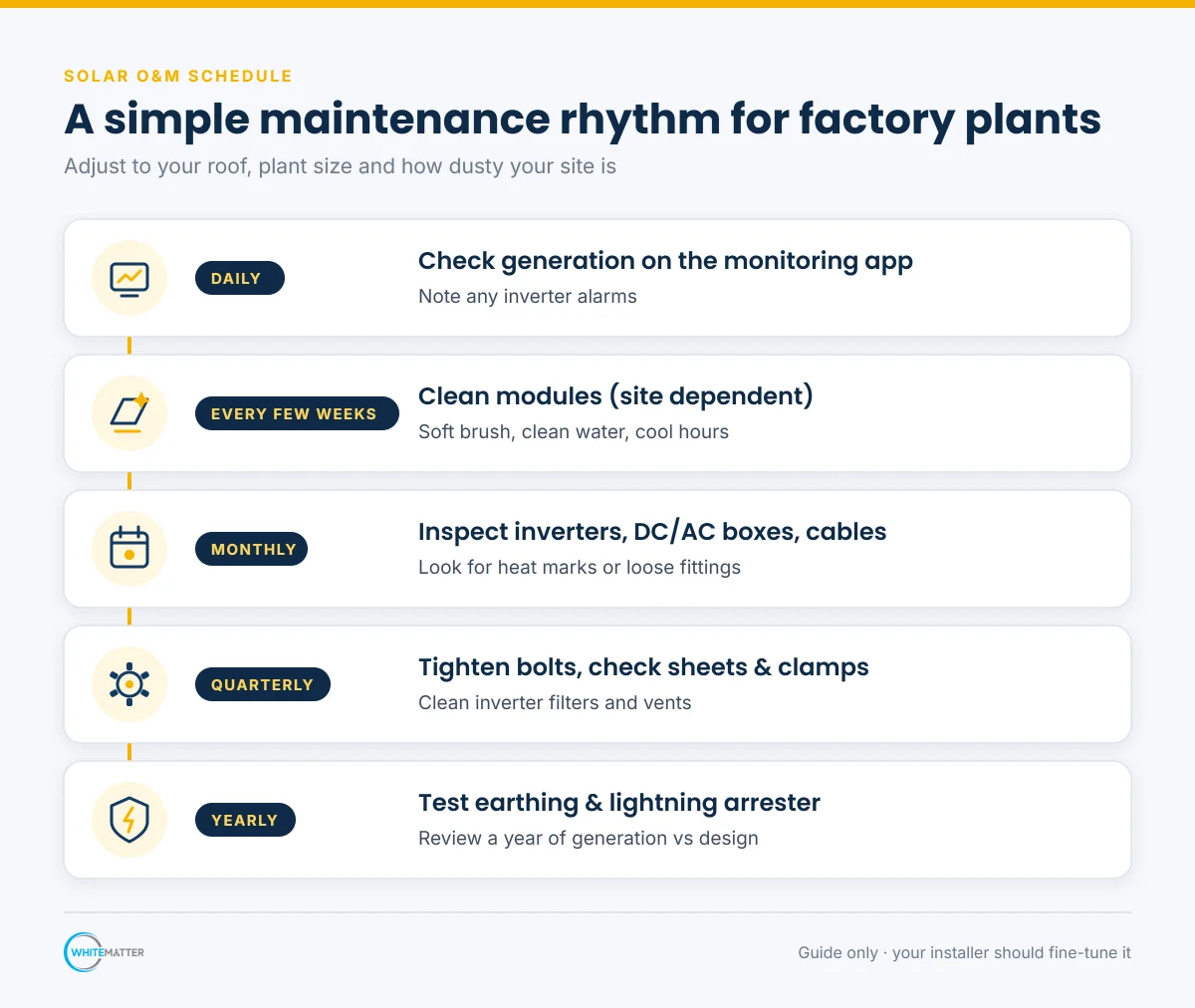
A simple maintenance schedule for factory plants
Use this as a starting point. Your installer should adjust it to your roof, plant size and site conditions.
| How often | What to do |
|---|---|
| Daily | Check generation on the monitoring app; note any inverter alarms. |
| Every few weeks (site dependent) | Clean modules; look for bird droppings, leaves and shading from new objects. |
| Monthly | Inspect inverters, AC/DC distribution boxes, cable routes and connectors for heat marks, damage or loose fittings. |
| Quarterly | Tighten structure bolts, check roof sheets and clamps for leaks or rust, clean inverter air filters and vents. |
| Yearly | Test earthing and lightning arrester, check insulation, review a full year of generation against the design estimate. |
Inverters, cables and earthing
The inverter is the heart of the plant. Keep it in a shaded, ventilated place, keep its vents free of dust, and act on every alarm. Most inverter makers give remote monitoring, so your O&M team can often spot a fault before you do.
On the roof, check that DC cables are tied neatly, protected from sharp sheet edges and not lying in water. MC4 connectors should be firmly locked and show no burn marks. Earthing pits and lightning arresters protect the plant and the building, so test them at least once a year and after any major storm.
What should a good solar AMC cover?
An AMC puts maintenance on a fixed plan with clear responsibility. The Delhi Government’s solar portal notes that it is normal practice for the solar vendor to maintain a rooftop plant for five years, and advises consumers to make sure this clause is in their agreement. It also notes that panels typically carry a 25-year warranty and inverters 5 to 7 years. Keep all warranty papers safe.
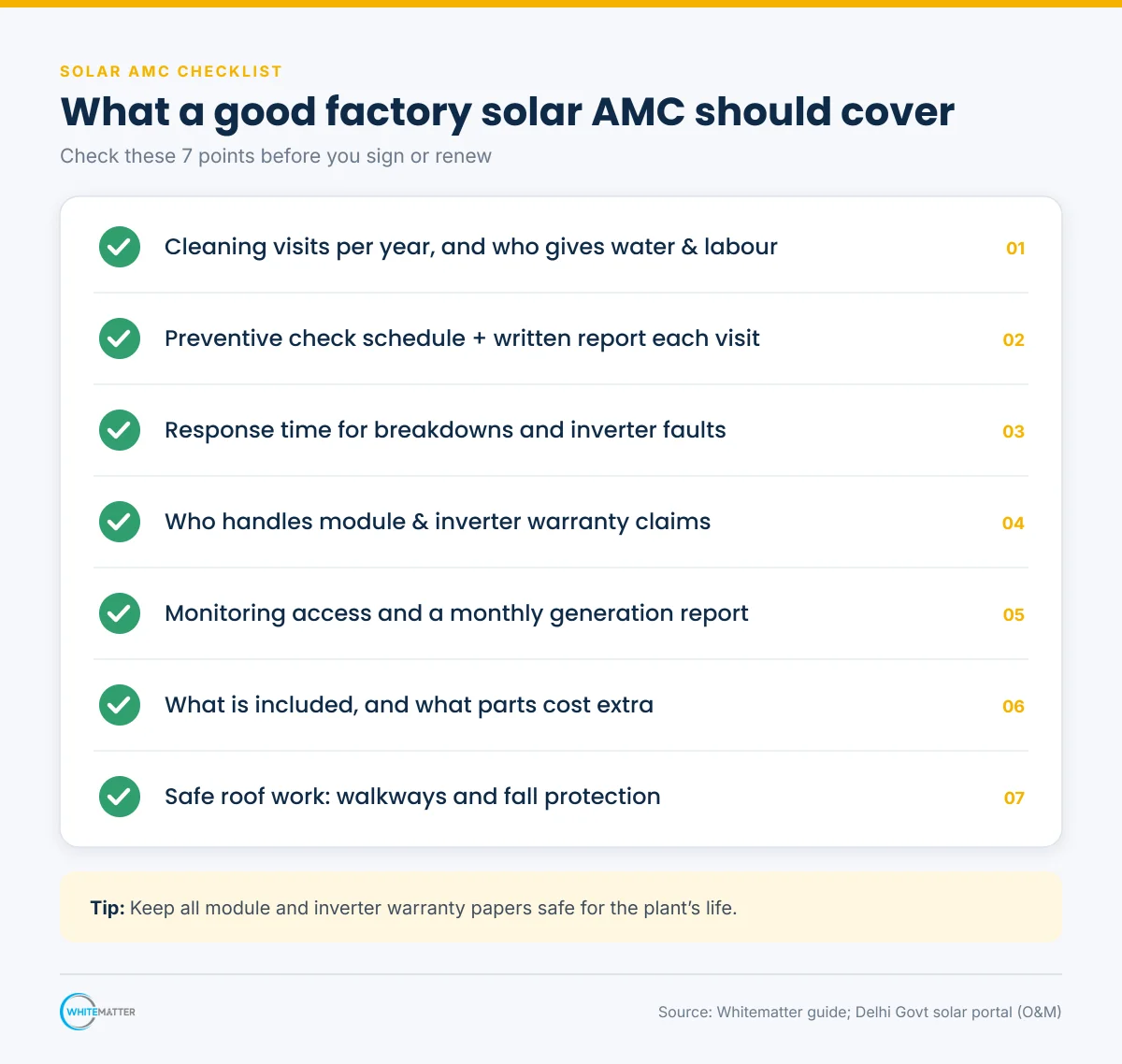
Before you sign or renew an AMC, check that it clearly states:
- Number of cleaning visits per year and who supplies water and labour.
- Preventive check schedule and a written report after each visit.
- Response time for breakdowns and inverter faults.
- Who handles warranty claims with module and inverter makers.
- Monitoring access and a monthly generation report.
- What is included, and what spare parts or repairs cost extra.
- Safety practices for roof work, including walkways and fall protection.
How Whitematter helps
Whitematter Energy Solutions offers solar maintenance and AMC for commercial and industrial plants in Ludhiana, Moga, Bathinda, Barnala, Mandi Gobindgarh and across Punjab. As an authorized Havells channel partner for industrial rooftop solar, we design and install plants with maintenance in mind from day one: safe walkways, neat cable routing and easy access to inverters. Our founder, Harpal Singh, is PMP®-certified with more than 17 years in the electrical energy industry. You can see some of our work on our projects page.
FAQs
How often should factory solar panels be cleaned?
It depends on how dusty the site is. Dusty sites may need cleaning every few weeks, cleaner sites less often. Watch your generation data; a drop on clear days usually means the modules need cleaning.
Can we clean the panels with our own staff?
Yes, if they are trained, use soft brushes and clean water, and follow roof safety rules. Electrical checks on inverters, DC boxes and earthing should be done by qualified technicians.
Does poor maintenance affect the warranty?
It can. Module and inverter makers set rules on cleaning and handling. Damage from wrong cleaning methods or walking on modules may not be covered, so follow the maker’s instructions.
Do you maintain plants installed by other companies?
Please contact us with your plant details. We will inspect the system and suggest a suitable maintenance plan.
Book a free plant assessment
Is your factory solar plant producing less than it should? Get a free plant assessment from Whitematter. Call or WhatsApp +91 99884 32432, email harpal@whitematter.in, or use our contact page.