

Should your factory buy its rooftop solar plant (CAPEX) or let a developer install it and sell you the power (RESCO / OPEX)? If your business has the funds or a loan line and pays enough tax to use depreciation, owning the plant under the CAPEX model usually gives the biggest long-term savings. If you want zero upfront cost and are happy with a long power purchase contract, RESCO can still cut your bill from day one.
Here is a simple CAPEX vs RESCO solar comparison and a checklist for factory owners in Ludhiana and across Punjab.
What is the CAPEX model?
CAPEX means capital expenditure. Your business pays for the solar plant, either from its own funds or with a bank loan, and owns it from the day it is commissioned. Every unit it produces is yours, free.
- You pay: the full project cost upfront (or through a loan).
- You own: the panels, inverters, structure and all the savings.
- You claim: accelerated depreciation on the plant against your business profit.
- You arrange: operation and maintenance (O&M), usually through an annual maintenance contract (AMC) with the installer.
What is the RESCO (OPEX) model?
RESCO stands for Renewable Energy Service Company. Under this model a developer invests in the plant, installs it on your roof and keeps owning it. You sign a long-term power purchase agreement (PPA) and pay only for the solar units you use, at a rate agreed in the contract. It is also called the OPEX model, because you pay an operating expense instead of buying an asset.
- You pay: nothing upfront, then a per-unit solar tariff every month.
- The developer owns: the plant for the contract period and looks after its O&M.
- The developer claims: the depreciation and other ownership tax benefits.
- You commit: your roof and your power purchase for many years, as per the PPA.
Are both models allowed in Punjab?
Yes. The PSERC rooftop solar regulations, as amended in April 2026, allow consumers either to own their rooftop system or to engage a RESCO developer. PSPCL signs the metering agreement with you as the electricity consumer; it does not get involved in commercial disputes between you and the RESCO. So the PPA you sign with the developer matters a lot.
The same capacity limits apply either way. Under net metering, plant size is linked to your sanctioned load or contract demand, with a cap of 500 kWp. Under net billing and gross metering it is linked to your sanctioned load or contract demand without the 500 kWp cap. See our guide on net metering vs gross metering for industries in Punjab.
CAPEX vs RESCO: side-by-side comparison
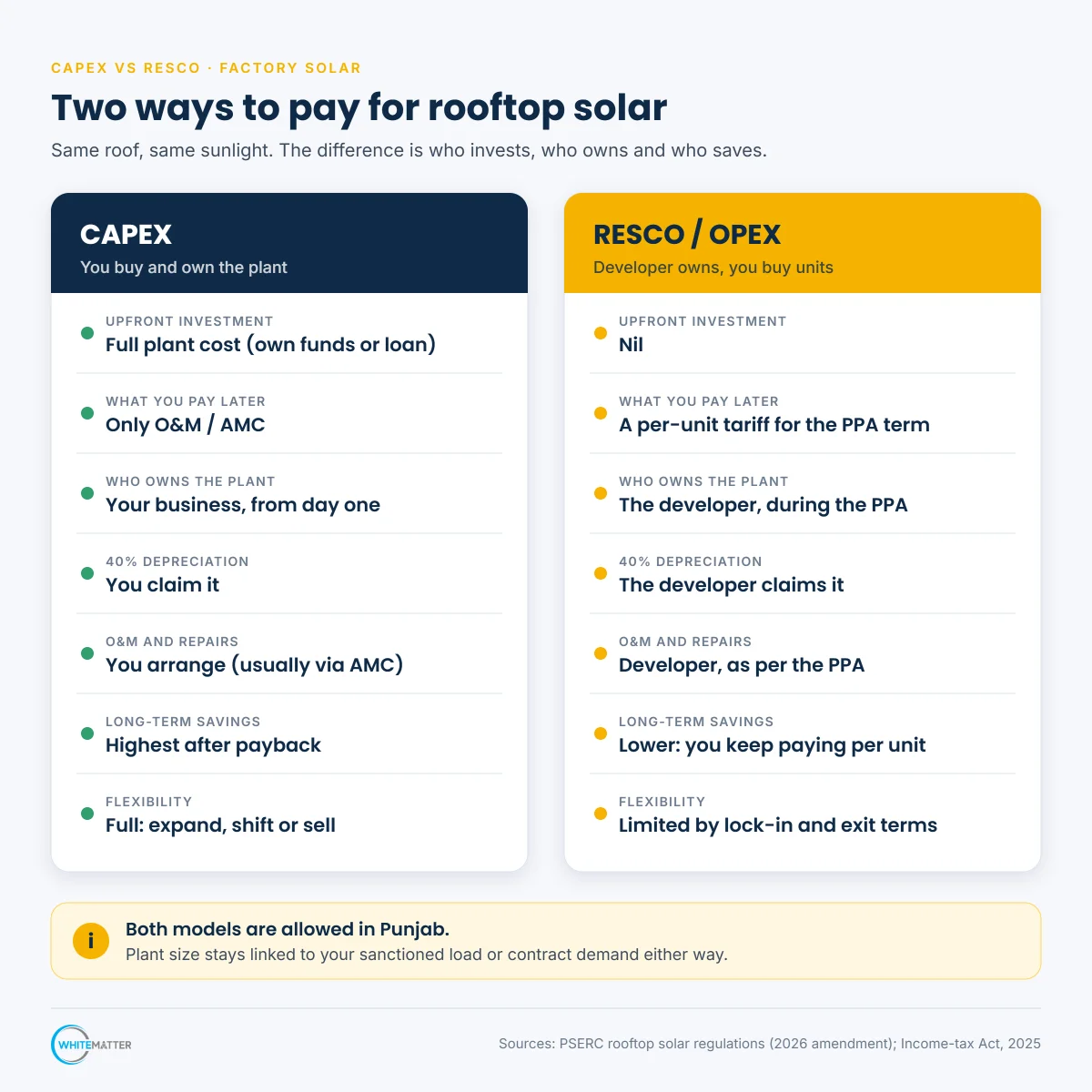
| Point | CAPEX (you own) | RESCO / OPEX (developer owns) |
|---|---|---|
| Upfront investment | Full plant cost, from own funds or a loan | Nil |
| What you pay later | Only O&M / AMC costs | A per-unit tariff for every solar unit, for the whole PPA term |
| Who owns the plant | Your business, from day one | The developer, during the PPA term |
| Accelerated depreciation | You claim it | The developer claims it |
| Long-term savings | Highest, as solar units cost you nothing after payback | Lower, because you keep paying the developer for each unit |
| Performance risk | Yours, managed through good design, warranties and AMC | Mostly the developer’s, since its income depends on generation |
| Flexibility | Full: you can expand, shift or sell the plant | Limited by the PPA (lock-in, roof access, exit terms) |
The tax angle: why ownership matters
Under income tax law, solar power generating systems sit in the renewable energy block that is depreciated at 40% on the written down value. This continues under the new Income-tax Act, 2025, which came into force on 1 April 2026. Only the owner of the plant can claim this. In a CAPEX project that is your business, so the tax saving shortens your real payback. In a RESCO project the developer owns the plant and takes the benefit.
The GST rate on solar power devices was also cut from 12% to 5% from 22 September 2025, which lowers the upfront cost of a CAPEX plant. Our article on accelerated depreciation on solar explains the 40% rule and the 180-day timing point with an example.
When does CAPEX make more sense?
- Your business is profitable and pays income tax, so depreciation has real value.
- You have spare funds or easy access to a term loan.
- You own the building and plan to stay for many years.
- You want the lowest cost per unit over the life of the plant.
When can RESCO be the better fit?
- Cash is needed for machinery, stock or working capital and you do not want to block it.
- The business does not have enough taxable profit to use depreciation.
- Your roof and occupancy are stable for the full PPA term.
Checklist before you decide
Go through these points with your CA and your solar partner:
- Compare cost per unit over the full life, not just the first year. Ask for the CAPEX payback and the RESCO tariff over the whole term in the same table.
- Check your tax position with your CA: how much of the 40% depreciation can you actually use?
- Read the PPA carefully: term, tariff and any yearly increase, minimum offtake, deemed generation, roof access, exit and buy-out terms, and what happens if you shift or sell the building.
- Confirm the metering route (net metering, net billing or gross metering) and that the plant size fits your sanctioned load or contract demand.
- Check roof life and structure. The roof must last as long as the plant or the PPA. See our guide to solar on tin-shed factory roofs.
- Ask who handles O&M, cleaning and breakdowns, and what generation is guaranteed.

How Whitematter helps factories go solar
Whitematter Energy Solutions is a Ludhiana-based solar company focused on commercial and industrial rooftop solar, and an authorized Havells channel partner for industrial rooftop solar. For businesses that choose to own their plant, we deliver a complete turnkey project: site assessment, 3D design and quotation, documentation and approvals, material delivery, installation and commissioning, inspection and handover, with maintenance and AMC support after that.
Our founder, Harpal Singh (PMP®), has 17+ years in the electrical energy industry. We serve Ludhiana, Moga, Bathinda, Barnala, Mandi Gobindgarh and all of Punjab. See our projects or visit our home page.
Frequently asked questions
Can I claim accelerated depreciation under a RESCO model?
No. Depreciation goes to the owner of the asset. Under RESCO the developer owns the plant, so the developer claims it. You simply book the monthly solar power bill as an expense.
Is a RESCO plant allowed with net metering in Punjab?
Yes. The PSERC rooftop regulations allow consumers to own the system or engage a RESCO developer. The same capacity limits linked to your sanctioned load or contract demand apply, and PSPCL signs its agreement with you as the consumer.
What happens at the end of a RESCO contract?
It depends on the PPA. Some contracts transfer the plant to the consumer at the end of the term, some offer a buy-out option earlier, and some ask the developer to remove the plant. Make sure this is written clearly before you sign.
Get a free plant assessment
Not sure which route suits your factory? Send us your last 12 PSPCL bills and a few roof photos, and we will assess your site and help you compare the numbers, free of charge. Call or WhatsApp +91 99884 32432, email harpal@whitematter.in, or contact us here.
Note: This article is general information, not financial or tax advice. Rules, tariffs and tax provisions change from time to time; please confirm the latest position with PSPCL, PSERC and your chartered accountant before you decide.
Sources
- Power Peak Digest – PSERC notifies rooftop solar rules with GNM and VNM (2026): RESCO option and capacity limits
- Income Tax Department – Income-tax Act, 2025 comes into force from 1 April 2026
- Income Tax Department – Income-tax Rules, 2026 (depreciation)
- PIB – GST on renewable energy devices rationalised to 5%
- MNRE – Draft guidelines and model PPA for solar plants in RESCO model (2020)